Bull Put Credit Spread Example: A Real SPX Trade
By VantureCap · Published July 12, 2026 · Updated August 2, 2026
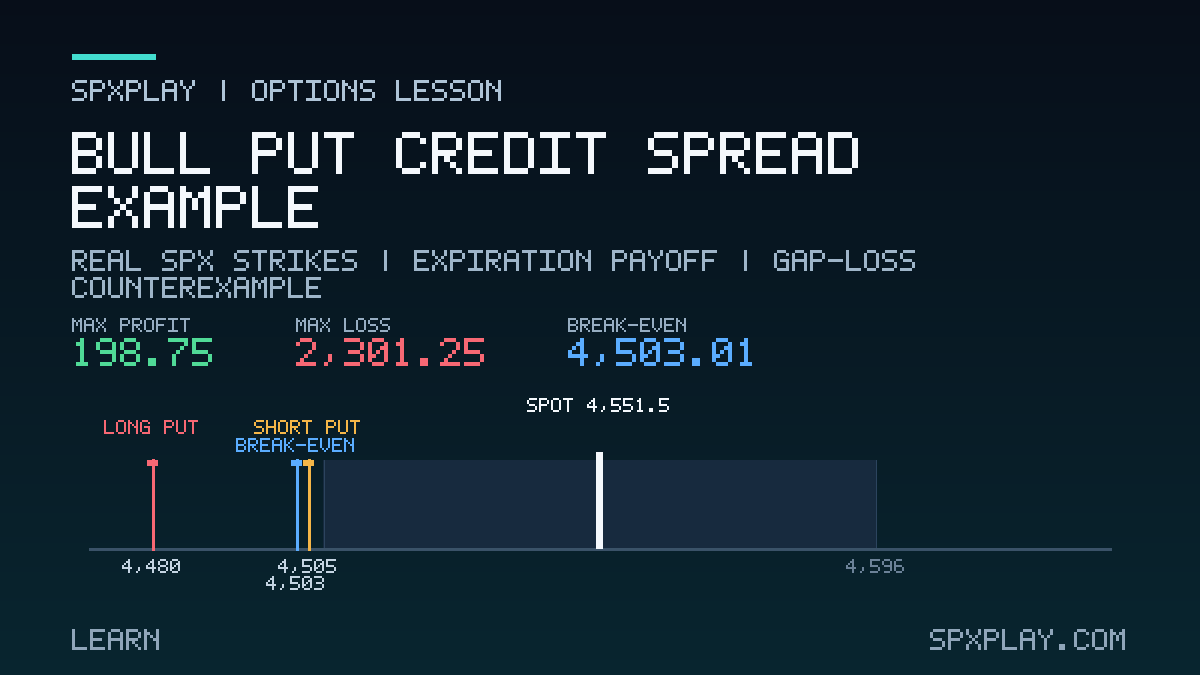
A bull put credit spread is two puts, same expiration: you sell a put below the market and buy a cheaper put further below it. The sale brings in more than the purchase costs, so you receive a net credit when you enter. That cash inflow is the most the spread can earn, but it is not realized profit while the position remains open. If the index finishes above your short strike at expiration, both puts expire worthless and the opening credit becomes the gross profit. If it finishes below your long strike, you take the maximum loss: the width between the strikes, minus the credit you collected.
- +$198.75max profitthe credit, 1 contract
- $2,301.25max loss$2,500 width − credit
- 4,503.01break-even at expiration4,505 − 1.9875
- 11.6×max loss ÷ creditone loss erases 11.6 wins
Here is one exactly as the trainer dealt it, priced from historical SPX option quotes (1 contract, ×100 multiplier):
| Leg | Strike | Action |
|---|---|---|
| Short put | 4505 | sell — the line you are defending |
| Long put | 4480 | buy — the floor that caps the damage |
Credit received is not profit yet
Until expiration, the two-leg package still has a market price. To exit early, you buy to close the whole spread. Your gross P&L is the opening credit minus that closing debit; commissions, fees, and fill differences come after that arithmetic.
gross P&L = credit received − debit paid to close (×100 per contract, before fees)
| Later package price | Gross P&L | What changed |
|---|---|---|
| $0.70 debit to close | +$128.75 | $198.75 received − $70 paid back |
| $3.10 debit to close | −$111.25 | $198.75 received − $310 paid back |
| $0 at expiration | +$198.75 max | both puts expire worthless |
Those rows are three points on one line, and the line is what matters: the number below which closing is a profit is the credit itself.
Closing price → gross P&L
closing here is a gross profitclosing here is a gross loss$0 gross — the credit itself
Knowledge check: credit versus profit
You collect $198.75, then the spread widens to $2.60. Buying it back costs $260, so the gross P&L is $198.75 − $260 = −$61.25. The account received cash at entry, but the open position lost value. Cash flow and profit are not the same.
For the mechanics behind that distinction, see the Options Industry Council’s bull put spread guide, which describes the opening credit as the strategy’s maximum possible gain and explains closing the spread early.
Why sell puts below an uptrend
The spread is a bet that something won't happen: SPX won't fall through 4505 in the next two sessions. That is a fundamentally different wager from “SPX will go up.” The index can rise, drift sideways, even dip — as long as it stays above the short strike, you keep the full credit. An established uptrend stacks the deck: drift is with you, and, all else equal, the passage of time generally helps the position. A price move or volatility change can still make the spread more expensive to close before expiration. Across the trainer's 1,051 historical SPX scenarios, the bull put credit finished profitable in 82% of UP-trend setups and 90% of STRONG_UP setups.
The 4505/4480 mental model
Think of the two strikes as jobs, not numbers. The short 4505 put is the line you are paid to defend — pick it where the tape would have to break character to reach it. The long 4480 put is a fire exit you bought in advance: below 4480 you cannot lose another dollar, no matter how ugly the tape gets. The credit-versus-width math tells you what the market thinks of your line. Here you collect $198.75 against a $25-wide spread ($2,500 of width) — roughly 8% of the width.
credit ÷ width = $198.75 ÷ $2,500 = 8.0% paid 8 to risk 92
You are being paid 8 to risk 92, which is the shape the payoff below draws. That ratio only makes sense when holding the line is much more likely than losing it, which is why strike selection, not the credit, is the whole trade.
Payoff at expiration
profit at expirationloss at expirationbreak-even 4,503.01spot when the trade was dealt
The setup, as dealt
Fifty daily sessions, dates masked, entry at the dashed line. The tape had been grinding higher — up 1.5% over 5 sessions, sitting 0.2% off its 20-day high — with VIX at 15.4 in a calm regime.
SPX · last 50 sessions · dates masked · entry 4,551.54
Whether that short strike is far enough is a question in the market's own units, so the price map below puts the 4505 line next to one VIX-implied session of movement.
Price map at entry
keeps the full creditlosing at expirationshort 4,505 putone VIX-implied day
All four verticals priced at that entry, for context:
| Spread | Strikes | Entry | Max profit | Max loss | Breakeven |
|---|---|---|---|---|---|
| Bull put credit | 4505 / 4480 | +$198.75 credit | $198.75 | $2,301.25 | 4,503.0 |
| Bear call credit | 4575 / 4600 | +$417.50 credit | $417.50 | $2,082.50 | 4,579.2 |
| Bull call debit | 4555 / 4605 | −$1,237.50 debit | $3,762.50 | $1,237.50 | 4,567.4 |
| Bear put debit | 4550 / 4500 | −$1,207.50 debit | $3,792.50 | $1,207.50 | 4,537.9 |
Which choice do you expect to work best?
Commit to a read before revealing. Your selection also plots that structure's short strike, long strike, and breakeven.
No prediction selected yet.
Reveal what happened
Open the reveal to play the hold period candle by candle.
Reveal: the sessions after entry
SPX went essentially nowhere — two sessions later it settled at 4,551.68, a move of 0.00%. The hold low was 4,537: the short 4505 put was never within 30 points of being tested.
| Spread | Outcome | P&L |
|---|---|---|
| Bull put credit | expired worthless (win) | +$197.45 |
| Bear call credit | expired worthless (win) | +$416.20 |
| Bull call debit | no travel, full debit lost | −$1,238.80 |
| Bear put debit | no travel, full debit lost | −$1,208.80 |
The lesson: the market did nothing, and the bull put credit got paid in full anyway. That is the entire personality of this structure. It doesn't need a rally; it needs the absence of a selloff. Both debit spreads on the same tape lost their entire premium because “nothing happened” is fatal to a trade that needs travel — and it is exactly what the put seller ordered.
When it dies: the gap through the short strike
Now the honest half. In another scenario from the same dataset — also an UP-trend, calm tape, VIX under 16 — the trainer priced a bull put credit at 7505/7465 for a $482.50 credit, 2 DTE. A high-impact jobs report landed during the hold. SPX slid 2.61%, traded down through 7,369, and settled far below the short strike. The spread lost $3,518.80 — about 7.3 winning trades' worth, erased in two sessions. The long 7465 put did its job (the loss stopped there), but “defined risk” is not small risk.
The dataset is blunt about this. Taken blindly across all 436 uptrend scenarios, the bull put credit won 85% of the time with an average win of $320 — and an average loss of $1,831. That nets out to roughly zero. The structure has no free edge; whatever edge exists comes from reading the tape and skipping the setups where the line can't hold, which is precisely the rep the trainer drills.
436 uptrend setups, taken blindly
what the winners contributewhat the losers cost
Keep learning
- Vertical spreads: the four structures side by side
- The bear call credit spread, in depth
- Debit spreads: paying for direction
- Seven beginner spread mistakes (and what they cost)
- How to read a spread payoff diagram
- What defined risk really means
Finish this lesson
Mark it complete to update your browser-local skill profile. No account, tracking, or cloud sync.
Playbook Trainer is an educational game built on historical market data. Nothing on this page is investment advice or a recommendation to trade. Options involve substantial risk; defined-risk spreads can lose their full maximum loss. Scenario dates are masked, and prices reflect historical option quotes with simplified fills.