Bear Call Credit Spread Example: Selling the Rally
By VantureCap · Published July 12, 2026 · Updated July 29, 2026
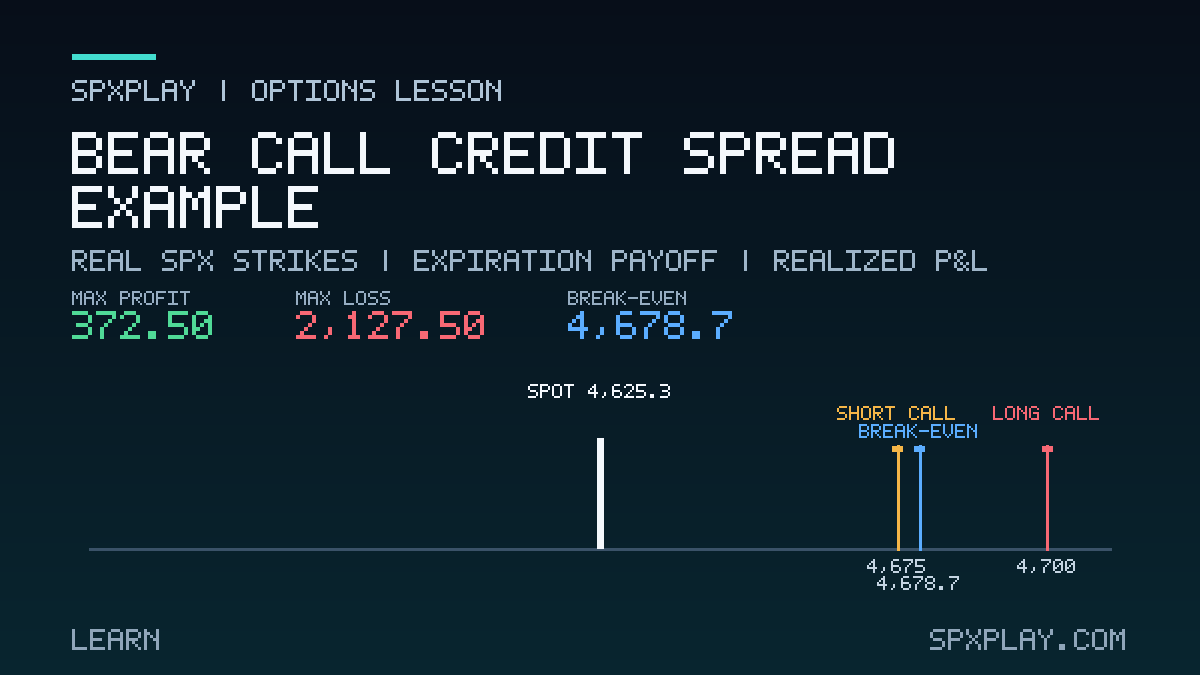
A bear call credit spread is the mirror image of the bull put credit: two calls, same expiration. You sell a call above the market and buy a cheaper call further above it, collecting a net credit. If the index finishes below your short strike at expiration, both calls expire worthless and you keep the credit. If it finishes at or above your long strike, you take the maximum loss — the width between strikes minus the credit. The expiration result depends on where SPX settles, not on whether it briefly crosses a strike earlier in the hold.
- +$372.50max profitthe credit, 1 contract
- $2,127.50max loss$2,500 width − credit
- 4,678.7break-even at expiration4,675 + 3.725
- 5.7×max loss ÷ creditone loss undoes 5.7 wins
The short strike is not a tripwire
Before expiration, the spread has a changing two-leg market price. A rally through the 4,675 short call can make the position show a loss, but it does not by itself lock in the expiration loss. If the spread stays open, settlement determines the final intrinsic value. If you close early, the package price you pay to buy it back determines the realized result. The payoff below is drawn against settlement price for exactly that reason.
Payoff at expiration
profit at expirationloss at expirationbreak-even 4,678.73spot when the trade was dealt
Knowledge check: touch versus settlement
Suppose this 4,675 / 4,700 call spread collects $372.50. SPX trades at 4,682 intraday, but the spread is not closed and SPX later settles at 4,660. Both calls expire worthless, so the expiration result is the full $372.50 gross profit, before fees and fill differences. The intraday touch may have made the live quote uncomfortable; it did not turn the short strike into a barrier.
Reference: the Options Industry Council bear call spread guide maps profit and loss to the underlying price at expiration. SPX options are European-style and cash-settled; they can still be closed with an offsetting trade before expiration.
The hard truth about fighting uptrends
Structurally the two credit spreads are twins. Statistically they are not, because equity indexes drift up. Selling calls means standing in front of that drift, and the trainer's own dataset is blunt about the cost. Across its 436 uptrend SPX scenarios, the bear call credit still “won” 79% of the time — but the average win was $336 while the average loss was $1,544. At those prices you need to win about 82% just to break even, and you don't. The win rate is a sedative; the expectancy is negative.
break-even win rate = avg loss ÷ (avg win + avg loss) = $1,544 ÷ ($336 + $1,544) = 82%
Win rate versus the hurdle
what these trades wonwhat they needed to winnegative expectancy
The trainer's coach encodes this directly: it marks call credits AVOID in every single uptrend and chop scenario in the dataset, and only relaxes to REDUCED size when the trend is actually down. If you take one thing from this page: a rich-looking call credit against a rising tape is usually rich for a reason.
Coach verdicts, all 1,051 scenarios
Fade the rip, not the trend
So when does the structure earn its keep? There are two common answers, and the dataset tolerates only one of them.
Fade the rip
Inside a downtrend. The tape has been selling off, bounces hard for a day, and you sell a call spread above the bounce — betting the relief rally stalls below your strike.
Volatility helps you here twice: a stressed VIX fattens the call premium you collect, and failed bounces are the signature behavior of down tapes. This is the only variant the coach tolerates — and even then at reduced size.
Fade the chop
Selling the top of a sideways range. It wins often too, but the dataset shows chop call credits carry the same skinny-win/fat-loss profile.
That is why the coach refuses to bless those either: every chop scenario in the dataset is marked AVOID, exactly like the uptrends.
Bear call credit spread example: a real fade-the-rip
Fifty masked sessions, entry at the dashed line. The tape is in a downtrend — down 1.4% over 5 sessions, 2.5% off its 20-day high — but it has just ripped +1.3% in a single day. VIX sits at 27.2 and is rising, so call premium is fat. A high-impact jobs report is due during the hold.
SPX · last 50 sessions · dates masked · entry 4,625.33
The four verticals priced at that entry (1 contract, ×100 multiplier, historical quotes):
| Spread | Strikes | Entry | Max profit | Max loss | Breakeven |
|---|---|---|---|---|---|
| Bear call credit | 4675 / 4700 | +$372.50 credit | $372.50 | $2,127.50 | 4,678.7 |
| Bull put credit | 4560 / 4525 | +$540.00 credit | $540.00 | $2,960.00 | 4,554.6 |
| Bull call debit | 4635 / 4685 | −$1,660.00 debit | $3,340.00 | $1,660.00 | 4,651.6 |
| Bear put debit | 4625 / 4560 | −$1,975.00 debit | $4,525.00 | $1,975.00 | 4,605.3 |
Note how stress inflates the credits: $372.50 for a call spread 50 points above spot. In the calm-tape example on the vertical spreads page, a comparable call spread paid $225. Fear is what you are selling.
Same width, two volatility regimes
Which choice do you expect to work best?
Commit to a read before revealing. Your selection also plots that structure's short strike, long strike, and breakeven.
No prediction selected yet.
Reveal what happened
Open the reveal to play the hold period candle by candle.
Reveal: the sessions after entry
The bounce failed. SPX rolled over and fell 1.88%, settling at 4,538.43. The hold high of 4,653 never reached the 4675 short call.
| Spread | Outcome | P&L |
|---|---|---|
| Bear call credit | expired worthless (win) | +$371.20 |
| Bull put credit | short put breached on the slide | −$1,618.30 |
| Bull call debit | wrong direction, full debit lost | −$1,661.30 |
| Bear put debit | caught the whole move | +$4,523.70 |
The lesson is in the contrast. On this tape the other credit spread — the bull put — was the one that got run over, losing three credits' worth when the slide went through its short strike. And the bear put debit, which needed the selloff to actually happen, made twelve times what the call credit made.
A bear call credit gets paid the same $372.50 whether the market chops sideways or collapses; you are selling the rally, not buying the crash. One more honest detail: the trainer's coach scored this whole board RED — stand aside, with the call credit as the only structure not marked AVOID. VIX at 27 with a jobs print inside the hold is a board where being flat is a position too.
Keep learning
- Vertical spreads: the four structures side by side
- The bull put credit spread, in depth
- Debit spreads: paying for direction
- Seven beginner spread mistakes (and what they cost)
- Reading market context before you pick a trade
- What defined risk really means
Finish this lesson
Mark it complete to update your browser-local skill profile. No account, tracking, or cloud sync.
Playbook Trainer is an educational game built on historical market data. Nothing on this page is investment advice or a recommendation to trade. Options involve substantial risk; defined-risk spreads can lose their full maximum loss. Scenario dates are masked, and prices reflect historical option quotes with simplified fills.