Options Time Decay (Theta): The Clock Inside Every Option
By VantureCap · Published July 22, 2026 · Updated July 29, 2026
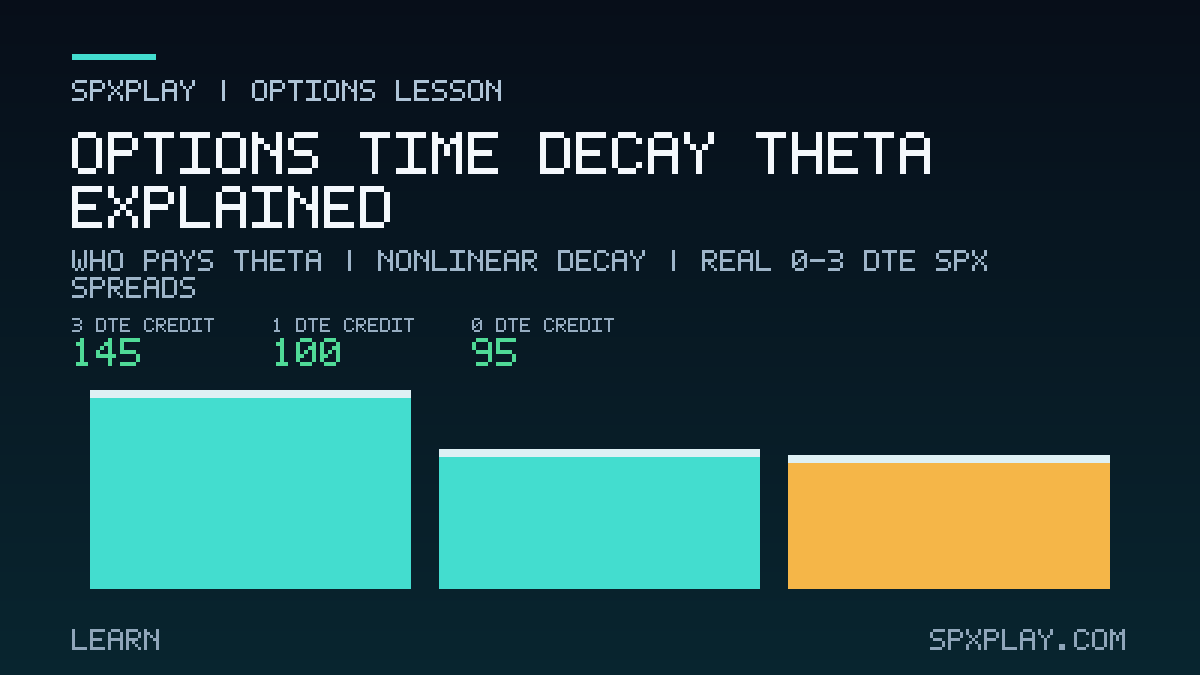
- $145credit at 3 DTE5.8% of the width
- $100credit at 1 DTE4.0% of the width
- $95credit at 0 DTE3.8% of the width
- −$3,412.55one card that gapped through38× the credit it collected
Every option premium splits into two parts. Intrinsic value is what the contract would pay if expiration happened right now: with SPX at 4,650, a 4,700 put carries 50 points of intrinsic value, while a 4,600 put carries none. Whatever the market charges above intrinsic is time value — the price of everything that could still happen before the deadline. An out-of-the-money option is pure time value: its entire premium is a bet on what the remaining sessions might do.
What actually decays
intrinsic value — exact, 50 ptstime value — illustrative height
Each day that passes deletes some of those possibilities, so time value bleeds away, and at expiration it is exactly zero — only intrinsic value settles. Theta is the name for that daily bleed: an estimate of how much an option's price will fall in one day if everything else stays put. That last clause matters. On any single day, a real move in the index or a jump in implied volatility can swamp theta completely. Decay is relentless on average and easily buried on any given afternoon.
Who theta pays
Time value flows one direction: from net buyers to net sellers. Whoever is short an option collects the bleed; whoever is long pays it. That is the entire business model of premium selling — and the entire headwind of premium buying.
A vertical spread holds one of each, so both legs decay and what matters is the net theta:
OTM credit spread — paid to wait
The short strike sits closer to the money and carries more time value than the long strike farther out, so the position is usually a net collector: if the index goes nowhere, the spread’s price drifts toward zero and the seller keeps the credit.
OTM debit spread — pays to wait
The mirror image: the leg you own is the expensive one, so the position usually pays theta each day it waits for its move.
“Usually” is doing honest work in both boxes: once a spread trades in the money, or in the final hours, net theta can behave differently. But for the out-of-the-money verticals the trainer deals, the rule of thumb holds: credit spreads are paid to wait, debit spreads pay to wait.
Options time decay is not a straight line
If time value bled evenly, a 30-day option would lose 1/30th of it per day. It does not. The shape of the bleed depends on where the strike sits:
Time value against the clock
at the moneymoderately out of the moneyfar out of the money0–3 DTE — every SPX card the trainer deals
An at-the-money option holds its time value stubbornly early on, then gives it up faster and faster into expiry — the famous acceleration that makes the last few days the steepest part of the curve. A moderately out-of-the-money strike decays more steadily. A far out-of-the-money strike never had much time value to begin with, loses most of it early, and flatlines near zero with days still left — there is nothing meaningful remaining to bleed. The shaded band is where the trainer lives: every SPX card deals an expiration 0–3 days out, on the steep end of the curve — and the three real credits in the next section are three samples from inside that band.
What 0–3 DTE credits actually collect
Here are three real SPX sessions from the trainer's pool — different days, not one spread tracked over time, but a deliberately matched shape: each is a bull put credit spread, 25 points wide, short strike about 1% below the index, all in a calm volatility regime. The only big difference is the clock:
| DTE at entry | VIX · regime | Short put | Width | Credit collected | Credit ÷ width |
|---|---|---|---|---|---|
| 3 | 13.7 · calm | 1.0% below entry | 25 pts ($2,500) | $145 | 5.8% |
| 1 | 12.4 · calm | 1.0% below entry | 25 pts ($2,500) | $100 | 4.0% |
| 0 | 14.5 · calm | 1.0% below entry | 25 pts ($2,500) | $95 | 3.8% |
Credit against width, 3 → 1 → 0 DTE
credit collectedthe rest of the width, still at risk
With three sessions of risk left, the market paid $145 to take the other side of that $2,500-wide spread. With one session left, a near-identical shape collected $100. On the morning of expiration itself, $95 — and that $95 had to decay to zero by the close, the whole curve compressed into hours. All three of these spreads finished out of the money and kept their credit, before fees and fill differences. Note what the last row does not show: the 0DTE credit is smaller, but not tiny. A strike 1% away is still well inside what one session can travel, and the market prices that honestly right up to the bell.
Knowledge check: where does the last $95 go?
The 0 DTE spread collected $95 with its short put at 4,390. If SPX settles anywhere above 4,390, both puts expire worthless: the spread's price goes from $95 to $0 in a single session and the seller keeps the credit, before fees and fill differences. If SPX instead drops through 4,390, intrinsic value replaces time value far faster than theta ever accrued — which is exactly the trade-off the next section prices.
Theta’s price: the same position can gap through you
Collecting decay is not free money; it is payment for standing in front of the market's moves. The position that bleeds value to you is, by construction, short the big move — sellers of premium are short gamma, and the bill arrives all at once.
A real card from the trainer's pool shows the honest arithmetic. Calm tape: VIX 15.0, a strong uptrend sitting at its 20-day high, SPX at 6,124. The bull put credit spread on offer was 35 points wide, short the 6,050 put — 1.2% below the index — three days to expiration, collecting $88.75. Then the index slid about 1.8% over the short hold and settled at 6,012, below both strikes. The result: −$3,412.55 with commission — essentially the position's full $3,411 max loss, roughly 38× the credit it was collecting. It would have taken 38 quiet trades like this one to earn back that single miss, before fees and fill differences.
The card that paid the bill
profit at expirationloss at expirationbreak-evenwhere it settled
Theta in the trainer
When you sell a credit spread on a card and hold it through the reveal, you are collecting theta session by session: every candle that forms without threatening the short strike is the bleed working for you, and the reveal's settlement decides whether you kept it. When you buy a debit spread, the same clock runs against you — the move has to arrive before the time value is gone.
The 0DTE cards are the limit case: the whole decay curve — and the whole short-gamma bill — compressed into one session. That is why they make such a sharp practice ground: one session, one settlement, and nowhere for the clock to hide.
Keep learning
- Implied volatility: the other force moving option prices
- Expected move: how far one session can travel
- 0DTE: the whole decay curve in one session
- Managing open spreads: holding versus closing early
- When not to trade: what five years of always collecting actually paid
Finish this lesson
Mark it complete to update your browser-local skill profile. No account, tracking, or cloud sync.
Playbook Trainer is an educational game built on historical market data. Nothing on this page is investment advice or a recommendation to trade. Options involve substantial risk; defined-risk spreads can lose their full maximum loss. Scenario dates are masked, and prices reflect historical option quotes with simplified fills.